Understanding the Technology Adoption Cycle
And How It Shapes the Future of Digital Products
Watch: Technology Adoption in Action
Watch on YouTube Shorts
See how we break down complex tech concepts into digestible content
Adoption has its progression
Building requires strong foundations
Creatorsbring new ideas
Innovation doesn't win on technology alone—it wins on adoption. The most brilliant products can fail if they never reach the hands of everyday users. Understanding the technology adoption cycle is the roadmap every digital product must follow to go from niche curiosity to mass-market dominance.
For founders, businesses, and creators building in the Mo ecosystem, this framework isn't just theory—it's the difference between building something cool and building something that changes the world.
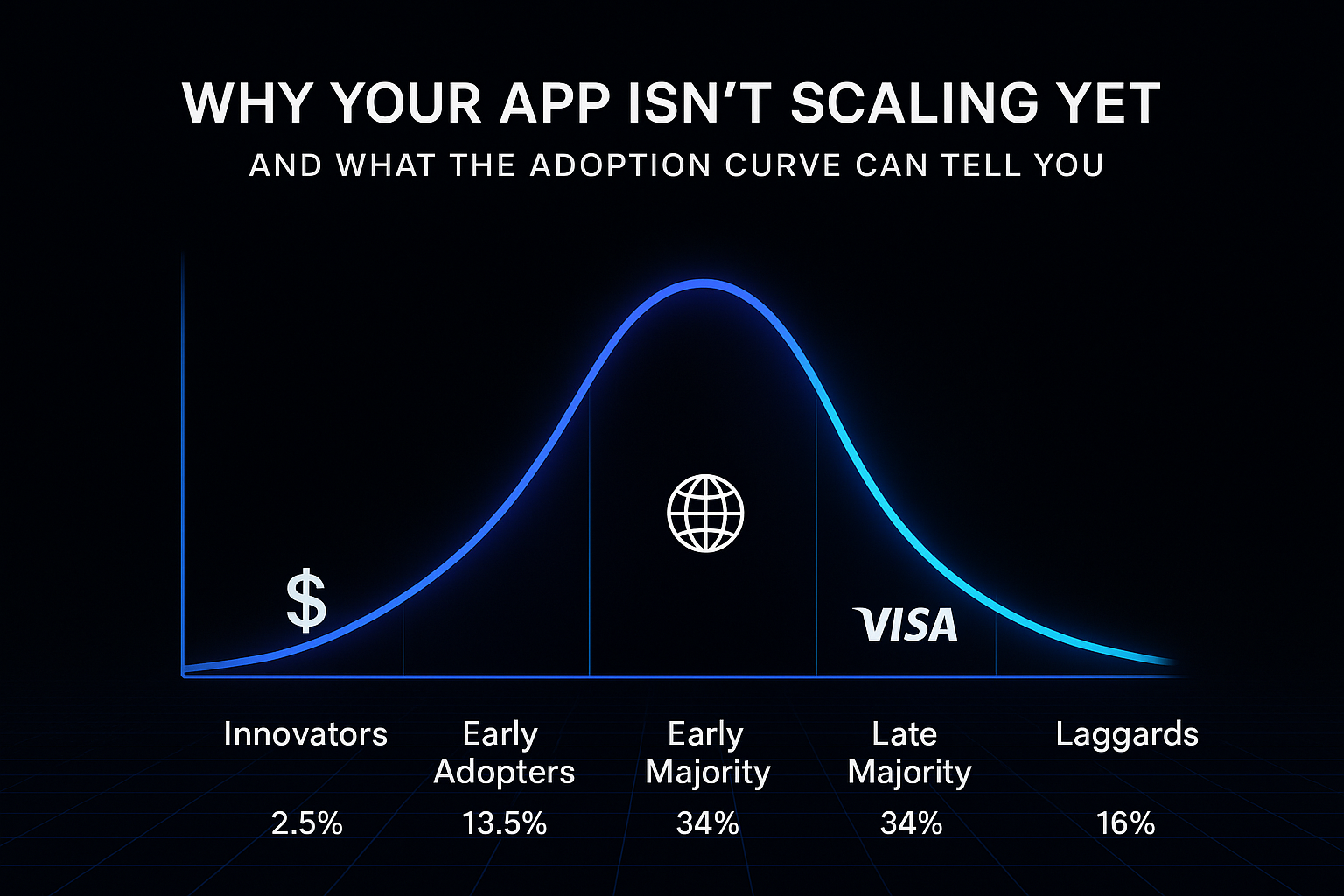
📊What Is the Technology Adoption Cycle?
The technology adoption cycle describes how new innovations spread through society. It divides users into five distinct segments based on when they embrace new technology:
⚠️ The Chasm
The gap between Early Adopters and the Early Majority is called "the chasm."This is where most innovations die. Early adopters love novelty, but the majority needs proven, simple, trustworthy solutions. Crossing this chasm is the difference between niche tech and mass-market dominance.
🎯Why Adoption Matters More Than Technology
Here's the uncomfortable truth: technology doesn't disrupt industries—adoption does.
- ✓The best product doesn't always win—the most understood and trusted one does.
- ✓Adoption equals distribution, trust, habit formation, and cultural acceptance.
- ✓Even revolutionary tech is worthless if nobody uses it.
🌍Real-World Examples Across the Adoption Curve
📧 Email — Mass Adoption in the Early 2000s
Early internet users experimented with email in the 1990s, but it wasn't until broadband internet and workplace integration that email achieved full global adoption around 2005. Today, it's the default channel for professional communication.
📱 Smartphones — Mass Adoption Around 2012
Early PDAs and BlackBerrys served innovators, but the iPhone (2007) changed everything. By 2012, smartphones had crossed the chasm into the Early Majority. Today, over 6 billion people own smartphones globally.
🚗 Uber — Mass Adoption Around 2016
Ridesharing apps were used by early adopters in major cities starting in 2010. By the mid-2010s, Uber became a household name, fundamentally changing urban transportation and spawning an entire gig economy.
🌐 The Internet — Mass Adoption Around 2005
The internet existed for innovators in the 1980s and early adopters in the 1990s, but majority adoption didn't happen until broadband infrastructure, smartphones, and social media converged in the mid-2000s.
💳 Visa & Digital Payments — Mass Adoption in the 1980s
Credit cards existed earlier, but widespread merchant acceptance and consumer trust didn't happen until the 1980s. Today, digital payments are the norm, with mobile wallets pushing the next wave of adoption.
🚀What This Means for Modern Digital Products
Digital products today—whether they're AI tools, FinTech apps, Web3 platforms, or creator economy solutions—follow the exact same adoption rules. Here's what that means:
Early adopters love innovation, but the majority needs clarity and trust
Don't assume what works for tech enthusiasts will work for everyone. Simplify your messaging as you scale.
Success is predictable once you identify your current segment
Know where you are on the curve. Are you serving innovators or ready to cross the chasm?
The future belongs to products that meet users where they are
At MoDevz and MoVestmentz, we build solutions that bridge the gap between cutting-edge technology and real-world usability.
Current Trends Following This Pattern:
- 🤖AI Tools: ChatGPT crossed the chasm in 2023; enterprise AI is still early majority
- 🎨Creator Economy: Platforms like Patreon and Substack entering late majority
- 💰FinTech: Digital wallets and mobile banking now mainstream
- ⛓️Web3: Still in early adopter phase for most consumer applications
🔑 What These All Have in Common
₿Bitcoin — A Real-World Adoption Curve in Motion
🌍 Market Size & Adoption Rate
- •As of 2025, only about 4% of the global population holds Bitcoin — despite its prominence, there remains a vast addressable market.
- •According to River Financial, Bitcoin's current global ownership puts it at roughly 3% of its total estimated adoption potential, meaning we're still in the early innings of a long growth curve.
🌎 Where Bitcoin Is Most Widely Adopted Today
- •The highest individual ownership rates are in North America, with the United States leading at an estimated ~14% BTC ownership among individuals.
- •Growing grassroots adoption is visible in Latin America, Africa, and parts of Asia, where Bitcoin is often used for remittances, inflation hedging, or as an alternative to unstable fiat — especially where traditional financial infrastructure is weak.
- •Emerging markets lead in per-capita and peer-to-peer usage, while developed markets dominate institutional holdings and merchant adoption.
🚧 Current Barriers to Wider Adoption
Despite the growth and promise, Bitcoin still faces significant hurdles:
- •Low global penetration — with only ~4% of people worldwide owning BTC, there is large room for mainstream adoption, but also a long road ahead.
- •Volatility and risk perception — Bitcoin's price swings and macro-economic uncertainty make many potential users and institutions hesitant to adopt it as a store of value or medium of exchange.
- •Regulatory uncertainty — differences in regulation, enforcement, and legal frameworks across countries complicate global mainstream use, especially in regions where citizens lack trust in local financial institutions.
- •Infrastructure & education gaps — lack of awareness, limited access to crypto-friendly platforms or stable internet/financial infrastructure, especially in developing countries, continues to limit adoption.
✅ What This Means: Bitcoin Is Still Early in the Curve
Because Bitcoin is still owned by a small fraction of the world's population — and many barriers remain — it behaves like a technology in the "Early Adopter → Early Majority" transitional phase. The potential is huge, but adoption growth will likely require continued improvements in:
- ✓Accessibility and user-friendly platforms
- ✓Regulatory clarity and institutional backing
- ✓Stability (or hedging mechanisms) to offset volatility
- ✓Education and trust-building initiatives
In other words: Bitcoin may have overcome the "innovators" stage — but it still needs to prove value, reliability, and ease-of-use to cross the chasm into mass adoption.
📈How to Move Your Product From Early Users to Mass Adoption
1. Build for Innovators, Communicate to the Majority
Innovators will try anything new, but the majority wants proof, simplicity, and safety. Your product features can be cutting-edge, but your marketing must be crystal clear.
2. Establish Trust & Social Proof
Nothing convinces the Early Majority like seeing others succeed. Leverage:
- • Customer testimonials and case studies
- • Industry certifications and partnerships
- • Media coverage and thought leadership
- • User-generated content and reviews
3. Simplify the Value Proposition
Remove complexity, reduce friction, increase adoption. Every extra step, every confusing feature, every moment of uncertainty pushes users away. Make it obvious why they need you.
4. Use Education & Content as Distribution
Content builds trust and educates potential users before they even try your product:
- • Blog posts that solve real problems
- • Tutorial videos and product walkthroughs
- • Social media content that demonstrates value
- • Email courses and onboarding sequences
5. Build Community
Early adopters don't just use products—they evangelize them. Give them a platform, a voice, and a reason to spread the word. Communities create network effects that accelerate adoption.
6. Timing Is Everything
Launch too early, and the market isn't ready. Launch too late, and you're competing with established players. Understanding where your market is on the adoption curve helps you time your strategy perfectly.
⚡Applying This Framework to MoDevz Digital Products
At MoDevz and MoVestmentz, we don't just build technology—we build adoption strategies.
Our cybersecurity tools, financial dashboards, and digital products are designed with the adoption curve in mind. We know that small businesses and entrepreneurs need more than just powerful features—they need solutions they can understand, trust, and implement immediately.
🛡️ Cybersecurity Solutions
Making enterprise-grade security accessible to small businesses crossing into the Early Majority.
📊 Analytics Dashboards
Simplifying complex data into actionable insights that drive business decisions.
💼 Business Tools
Building bridges between cutting-edge technology and real-world usability.
The bottom line: If small businesses want to scale in the next decade, understanding the adoption cycle is non-negotiable. Those who adapt early will lead. Those who wait will be left behind.
🎯Conclusion
The companies that win aren't the ones with the best technology—they're the ones that understand adoption.
Every digital product today sits somewhere on this curve. Whether you're launching an AI tool, a mobile app, a SaaS platform, or a Web3 solution, your success depends on knowing where you are and what it takes to move forward.
If you want to scale your business in the next decade, understanding the technology adoption cycle isn't optional—it's essential.
MoDevz Editorial Team
Published on November 17, 2025